Three shapes, and how each one runs.
A practice of one and a practice of twenty do not have the same problem. Find the one that looks like yours.
These are not customer stories. AudiologyMate is new and we will not put words in a practice's mouth, or a logo on this page, that we have not earned. What follows is the three shapes the product was built for, what each one's week looks like, and exactly which part of the product answers it, written so you can check every claim on the features page or in a demo.
You are the audiologist, the front desk and the bookkeeper
One set of rooms, your name on the door, and possibly one part-time person on reception. Nothing gets handed over because there is nobody to hand it to, which means every system you use has to be one you can run alone between patients.
What the week looks like
- Assessments in the morning, fittings and reviews in the afternoon, and the phone in between.
- Claims done after hours, because that is the only time there is.
- Reviews remembered, or found later in a spreadsheet or a diary, or not at all.
- The books handed to an external bookkeeper once a month.
What the system holds for you
- One record, so there is nothing to reconcile
- The client's tests, their aids and serials, their invoices, their claims and every message ever sent to them are one record seen from different angles. There is no second system to keep in step, which matters most when the person keeping it in step is also seeing patients.
- Claims batch and lodge without a second person
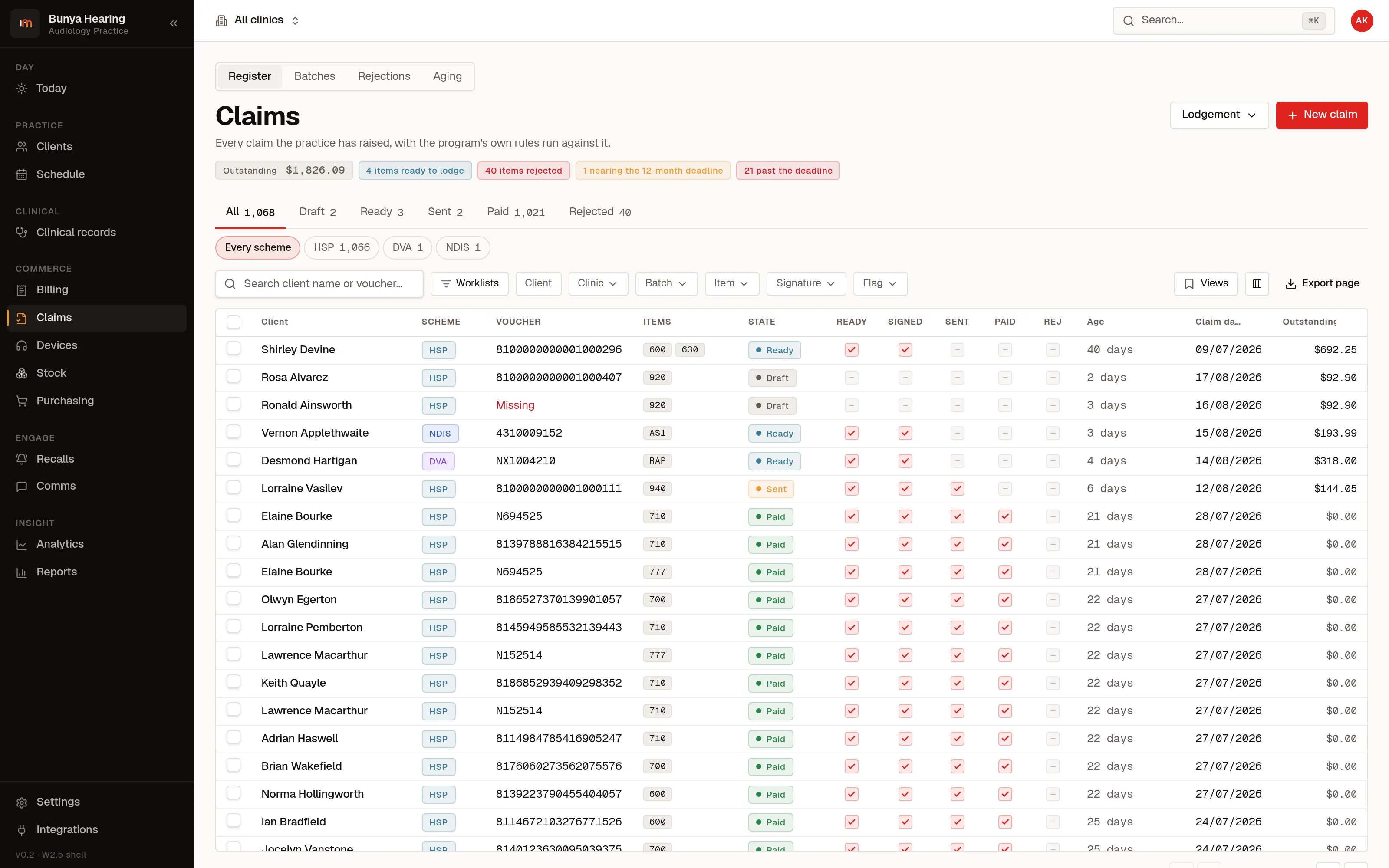
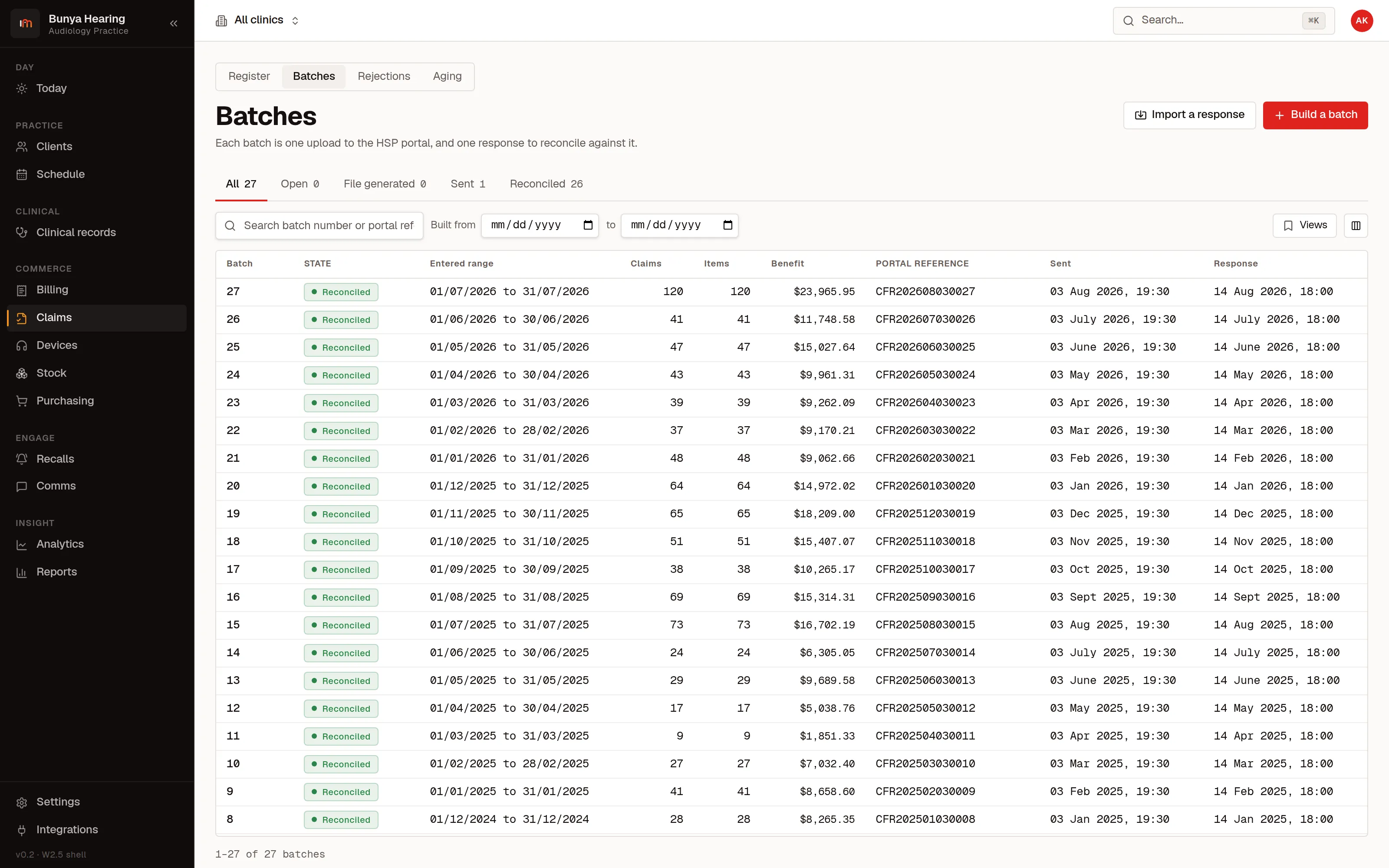
- Mark the Hearing Services items ready, batch them, send the file, import the return. Paid items pay themselves off and only the rejections need you, and each one carries the reason code the program sent back.
- The review comes out of the fitting date
- A recall rule counts from the date you fitted, so running the rules turns the aid you fitted today into a review that is due next year. You never have to remember to write it down.
- The averages come out of the audiogram
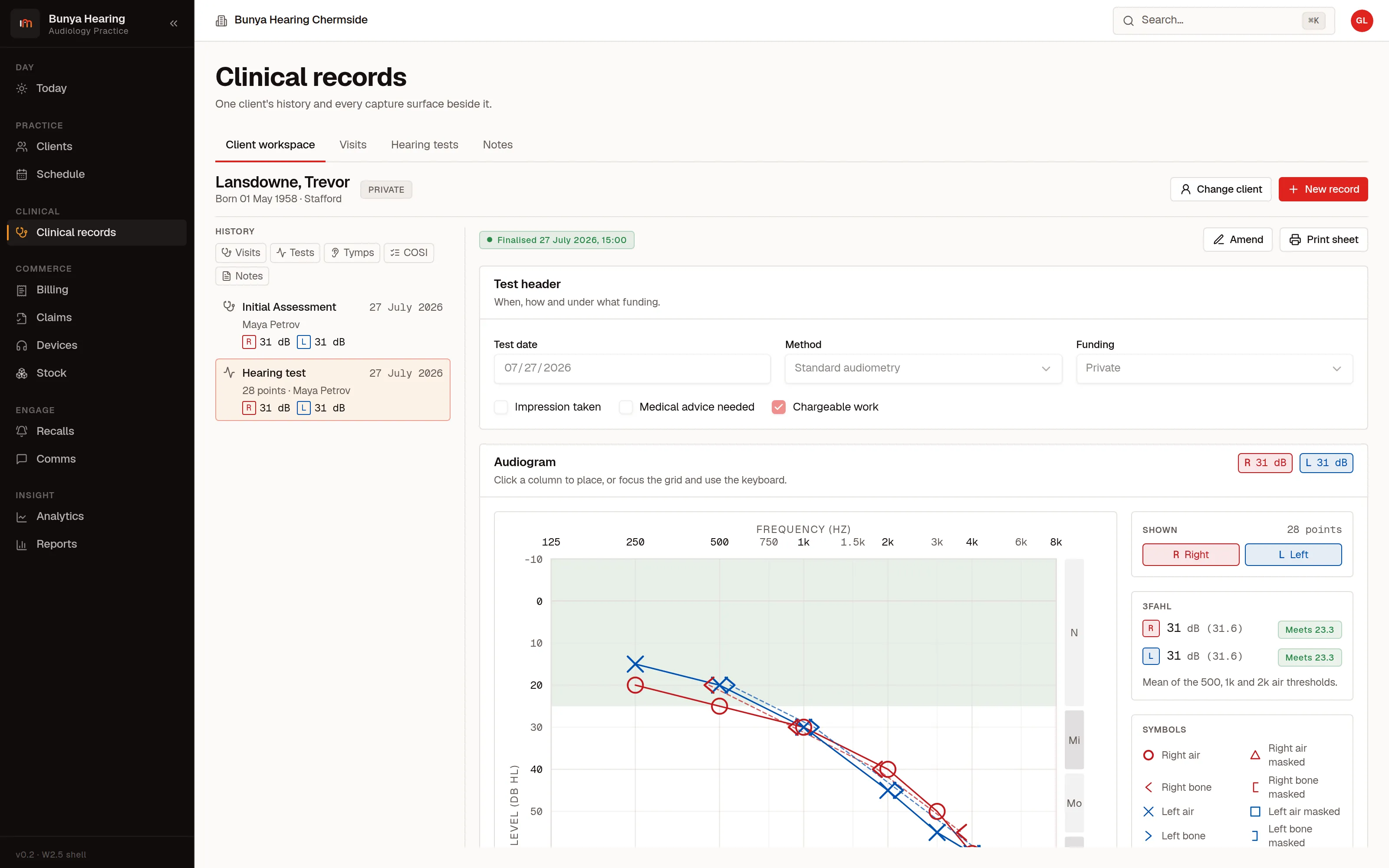
- Three-frequency average hearing level is computed from the thresholds, both ears, and each ear's verdict against the program's 23.3 dB fitting threshold sits beside the plot as you type. Percentage loss of hearing comes off the same thresholds through the weighting table you load.
- Your bookkeeper logs in instead of being emailed
- A finance-only seat sees invoices, payments and the financial reports, and cannot reach a clinical note. No monthly export, and no clinical data leaving in an email attachment.
What stops happening
- Typing an audiogram twice, once into the fitting software and once into the record. NOAH XML goes in and out.
- The spreadsheet of review dates.
- Working out 3FAHL on paper.
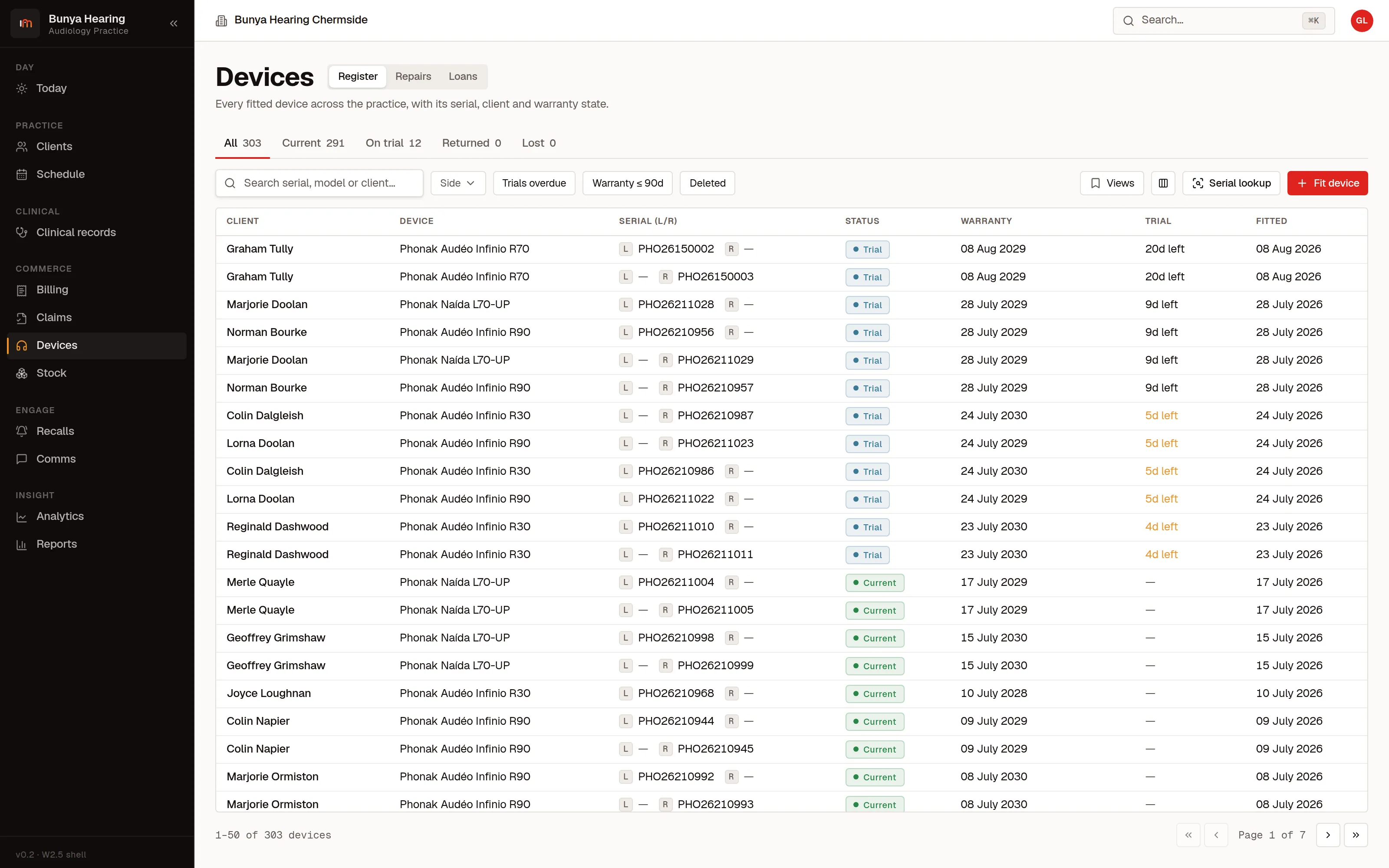
- Reconstructing which serial went to which client from an invoice and a memory.
What it costs at this size
- Audiologists
- 1
- Clinics
- 1Charged $0
- A month
- $400
- A year, paid up front
- $4,400One month free
1 × $350 + 1 × $50 = $400 a month
The clinic costs nothing. You pay for one audiologist, not for rooms. All 2 logins fit inside the 2 the audiologist carries, so no login is billed. The external bookkeeper is on a finance-only seat at $50. Every module and every role is included at every size. Prices in Australian dollars, excluding GST. From 10 audiologists the price is quoted rather than listed.
Some of the rooms are yours, and some you drive to
Your own practice two or three days a week, a fortnightly visit to a country town, a monthly afternoon at an aged-care facility, and a room you rent inside somebody else's clinic. Each place has its own patients, its own paperwork and its own provider site id. That last one is the part that catches people.
What the week looks like
- Monday and Tuesday at your own rooms.
- Every second Thursday two hours up the highway, with a boot full of stock.
- One Friday afternoon a month at a residential aged-care facility.
- Claims for all of it, correctly attributed to the site the work was done at.
What the system holds for you
- Each site claims as itself
- A clinic carries its own six-digit Hearing Services site id and its own invoice prefix, and claim batches are built per site. Claiming a visiting day under your main rooms' site id is the kind of error that is quiet until it is expensive.
- A rotation is a first-class thing
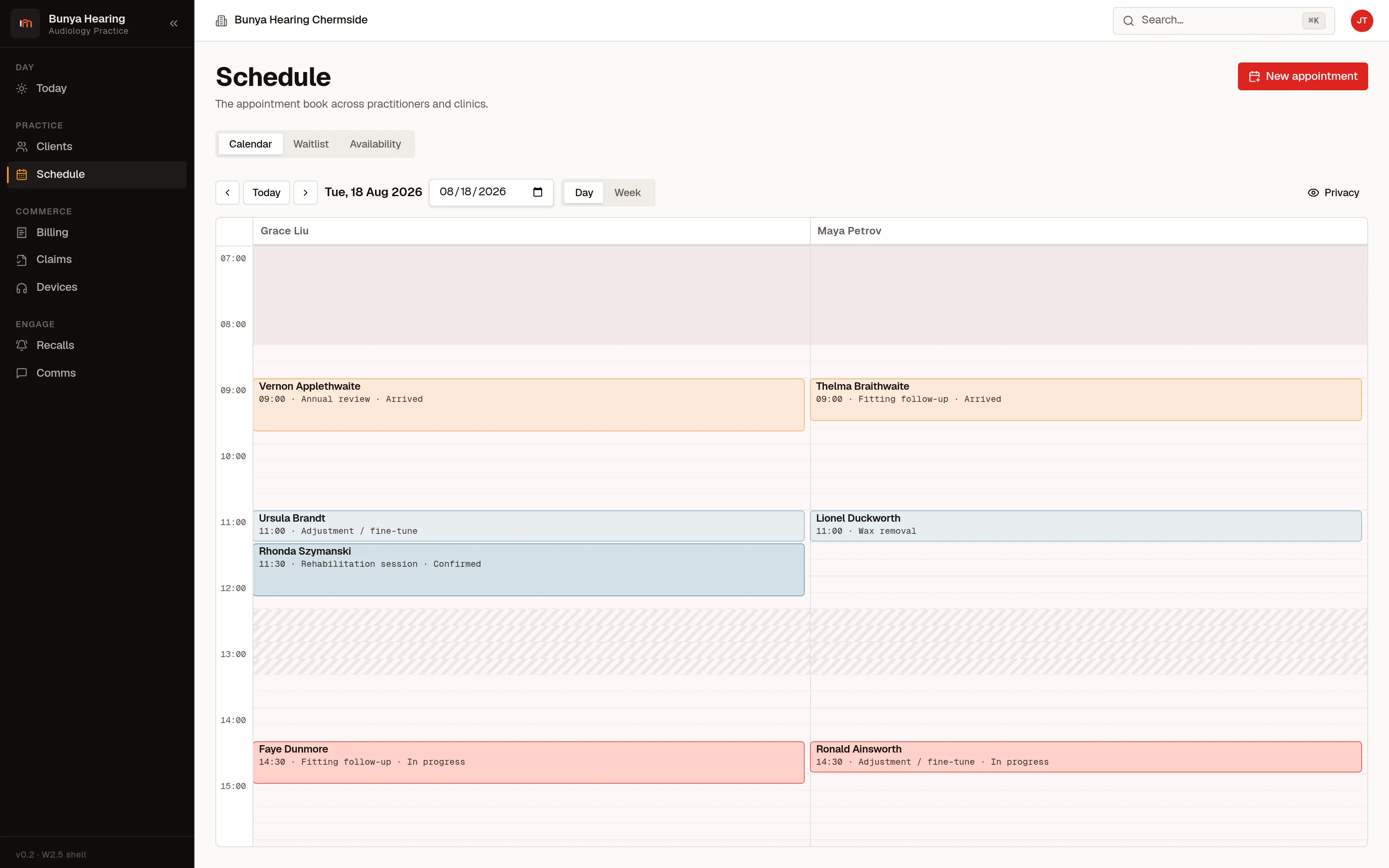
- Your working pattern at each site is a recurring roster with a start date and an end date: weekly, fortnightly, four-weekly or monthly. The fortnightly Thursday is one entry, not twenty-six appointments you place by hand.
- Each site has its own diary and its own queue
- The recalls due at the country clinic are that clinic's list, so a visiting day is planned from a list rather than from memory. That clinic's own summary says how much of the day, and of the week ahead, is still unbooked.
- Stock knows which site it is at
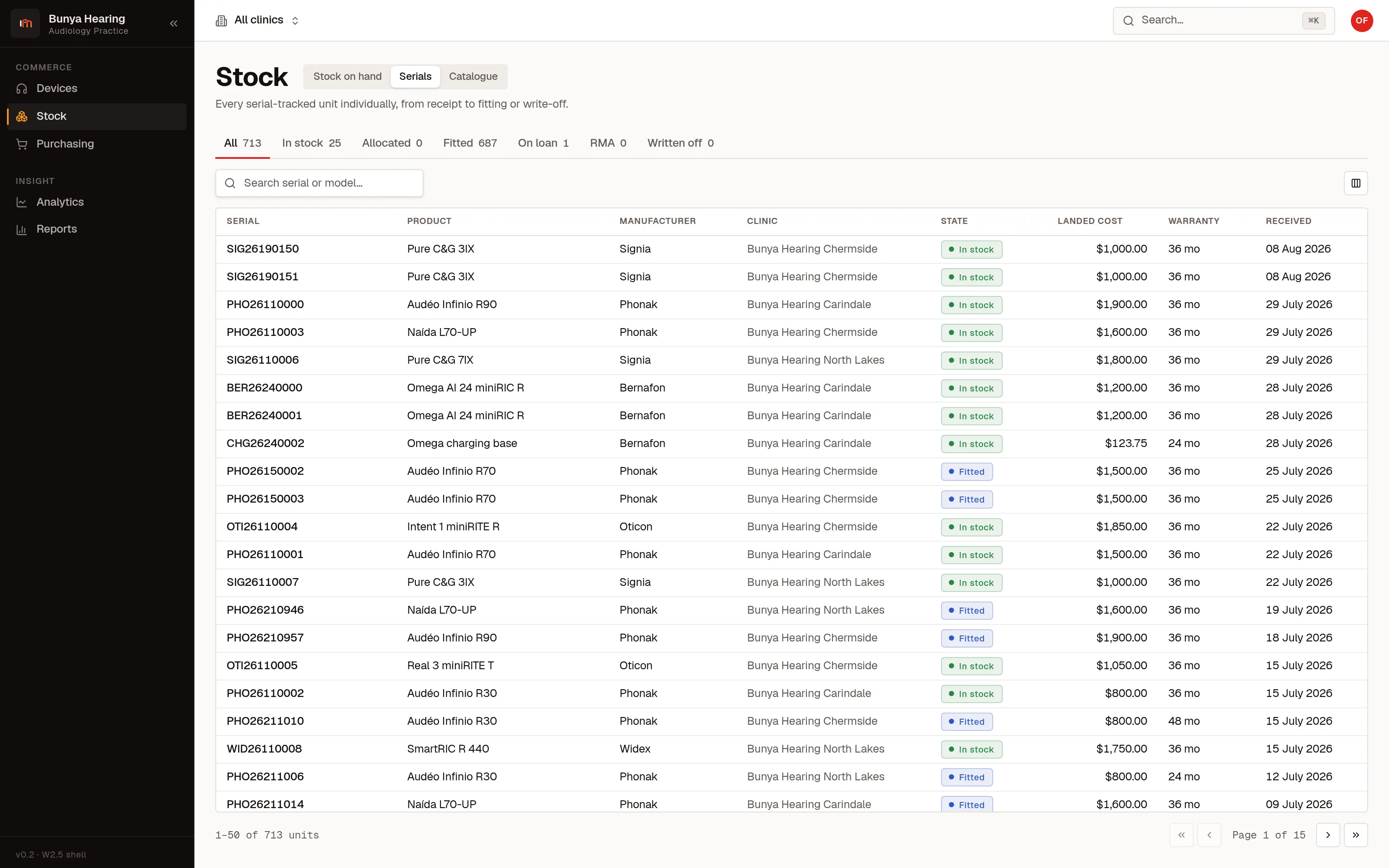
- On-hand counts are per clinic, and moving stock between sites is a transfer rather than a guess. What you took up the highway and what came back are both recorded.
- One client list across all of them
- The same person seen at two of your sites is one record. Your patients are yours, not the building's.
There is no separate “visiting clinic” mode, and that is deliberate: a site you visit is a clinic like any other, with its own id, its own address, its own diary and its own stock. What makes it a visiting site is your roster at it, which is a pattern you set once. None of it changes the bill: sites are free, so the four above cost the same as one. You are one audiologist whether you work in one room or five.
What stops happening
- Batching a visiting day's claims under the wrong site id.
- A separate diary, spreadsheet or notebook per site.
- Guessing what stock is where.
- Finding out on the drive home that the client you saw was due for a review you did not know about.
What it costs at this size
- Audiologists
- 1
- Clinics
- 4Charged $0
- A month
- $500
- A year, paid up front
- $5,500One month free
1 × $350 + 1 × $100 + 1 × $50 = $500 a month
All 4 sites cost nothing. You pay for one audiologist, not for rooms. 3 logins against the 2 included, so 1 is billed at $100. The external bookkeeper is on a finance-only seat at $50. Every module and every role is included at every size. Prices in Australian dollars, excluding GST. From 10 audiologists the price is quoted rather than listed.
Several clinics, several audiologists, and somebody has to see the whole thing
Three or four sites, several audiologists and audiometrists, front desk at each, someone running operations across all of them, stock moving between them, and an external bookkeeper who logs in monthly. The hard part stops being any single task and becomes keeping the sites consistent with each other.
What the week looks like
- Each clinic runs its own day, with its own arrivals, its own gaps and its own recalls.
- Audiologists move between sites; some are based at one and visit another.
- Stock moves between sites, and cost of goods has to survive the trip.
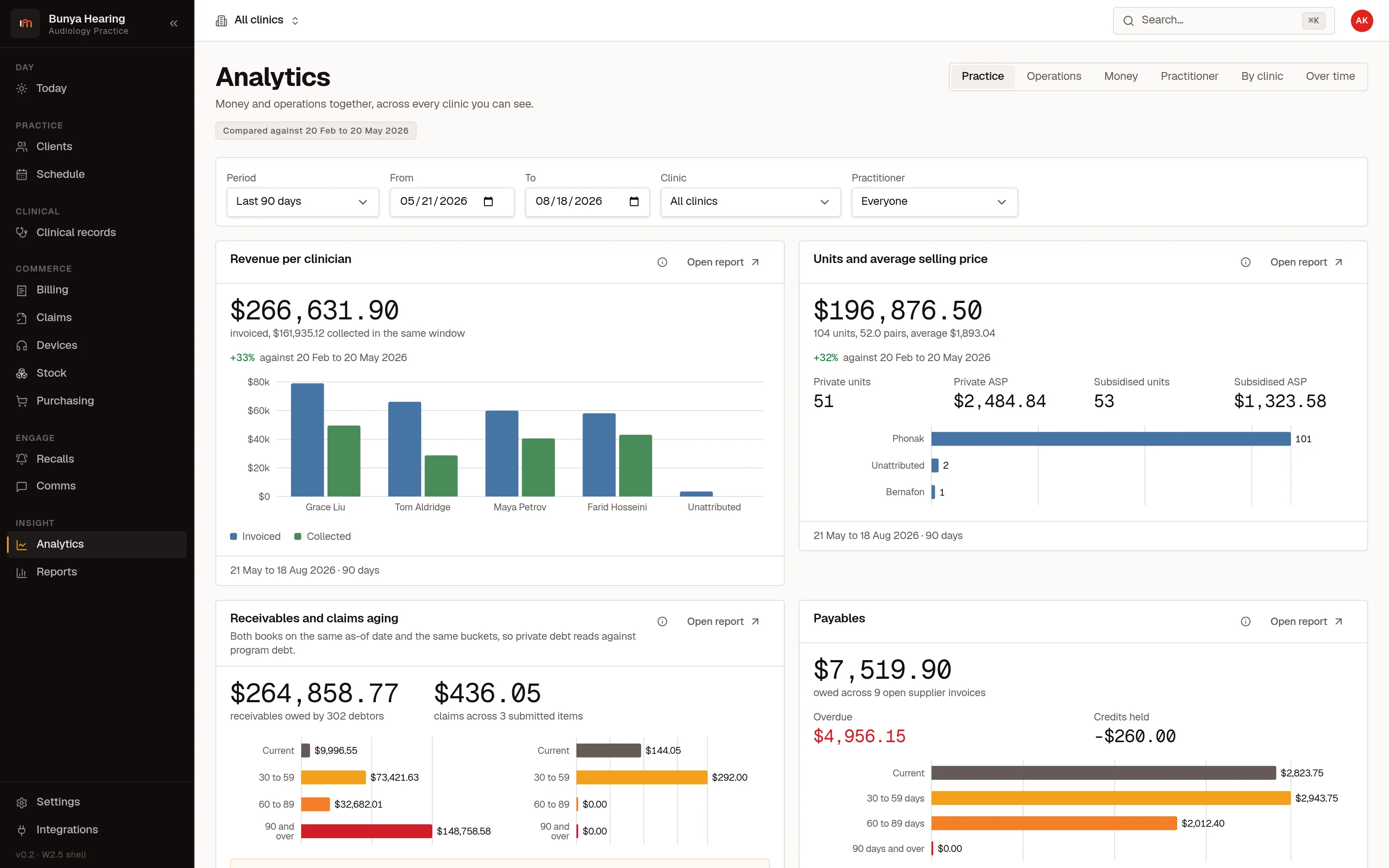
- The owner wants to know which clinic and which audiologist is actually converting.
What the system holds for you
- People see their own site by default
- Clinic access is a set of grants on someone's membership. “Receptionist at Chermside and Carindale” is two grants; a practice manager sees every site; an audiologist sees where they are rostered.
- Numbers that reconcile across sites
- Utilisation, did-not-attend rate, conversion from assessment to fitting, units, average selling price and revenue, per clinic and per audiologist, on the same definitions. Every figure opens into the rows beneath it.
- One claim register, batched per site
- Everything owed to the practice is one list with one aging report, while the files that go to the program are still built per site id, which is what the program requires.
- Serial to client to invoice, across sites
- An aid ordered centrally, received at one clinic, fitted at another and invoiced to a client is still one chain. Real cost of goods survives that, which an average cost would not.
- Every change has a name against it
- The audit log records who changed what, with the before and the after, in the same transaction as the change itself, so there is no mutation without its row. In a practice where several people touch the same client, that is the difference between a question and an argument.
- Adding the fourth clinic is data entry
- A new site is a clinic record, its site id, its rooms and a roster. Nothing is rebuilt and nothing is re-licensed.
What stops happening
- Emailing spreadsheets between sites to answer one question.
- A receptionist at one site seeing another site's queue.
- Four separate claim processes that have quietly drifted apart.
- Guessing which audiologist converts assessments into fittings.
What it costs at this size
- Audiologists
- 4
- Clinics
- 4Charged $0
- A month
- $1,500
- A year, paid up front
- $16,500One month free
4 × $350 + 2 × $50 = $1,500 a month
All 4 sites cost nothing. You pay for audiologists, not for rooms. All 8 logins fit inside the 8 the audiologists carry, so no login is billed. The external finance-only seats are $50 each. Every module and every role is included at every size. Prices in Australian dollars, excluding GST. From 10 audiologists the price is quoted rather than listed.
Moving from one shape to the next.
Practices grow along exactly this path: the solo audiologist takes a second room, the second room becomes a second clinic, the second clinic needs a second audiologist. The usual cost of growing is a migration onto a system that can cope with the new shape.
- Adding a clinic is data entry
- A name, an address, a provider site id, an invoice prefix, its rooms and who works there. It adds nothing to your bill, because sites are free however many you run, and there is no larger plan to move to.
- Adding a person is a seat
- Invite them, pick their role, grant their clinics. Their permissions come from the role, so nobody has to remember which fourteen things a receptionist may do. A new audiologist is $350 and brings 2 logins with them; anyone else is either inside those logins or $100 a month.
- Your history comes with you
- Migrations from Fitting Wizard and CorePlus bring clients, hearing tests, devices and their serials with the warranty clocks still running, and claim history. Scoped and quoted against your database before anything is agreed.
- Nothing is held back for a bigger plan
- A single-clinic practice gets the same claims engine, the same audit log and the same reporting as a group. The only thing that changes with size is how many audiologists you are paying for.
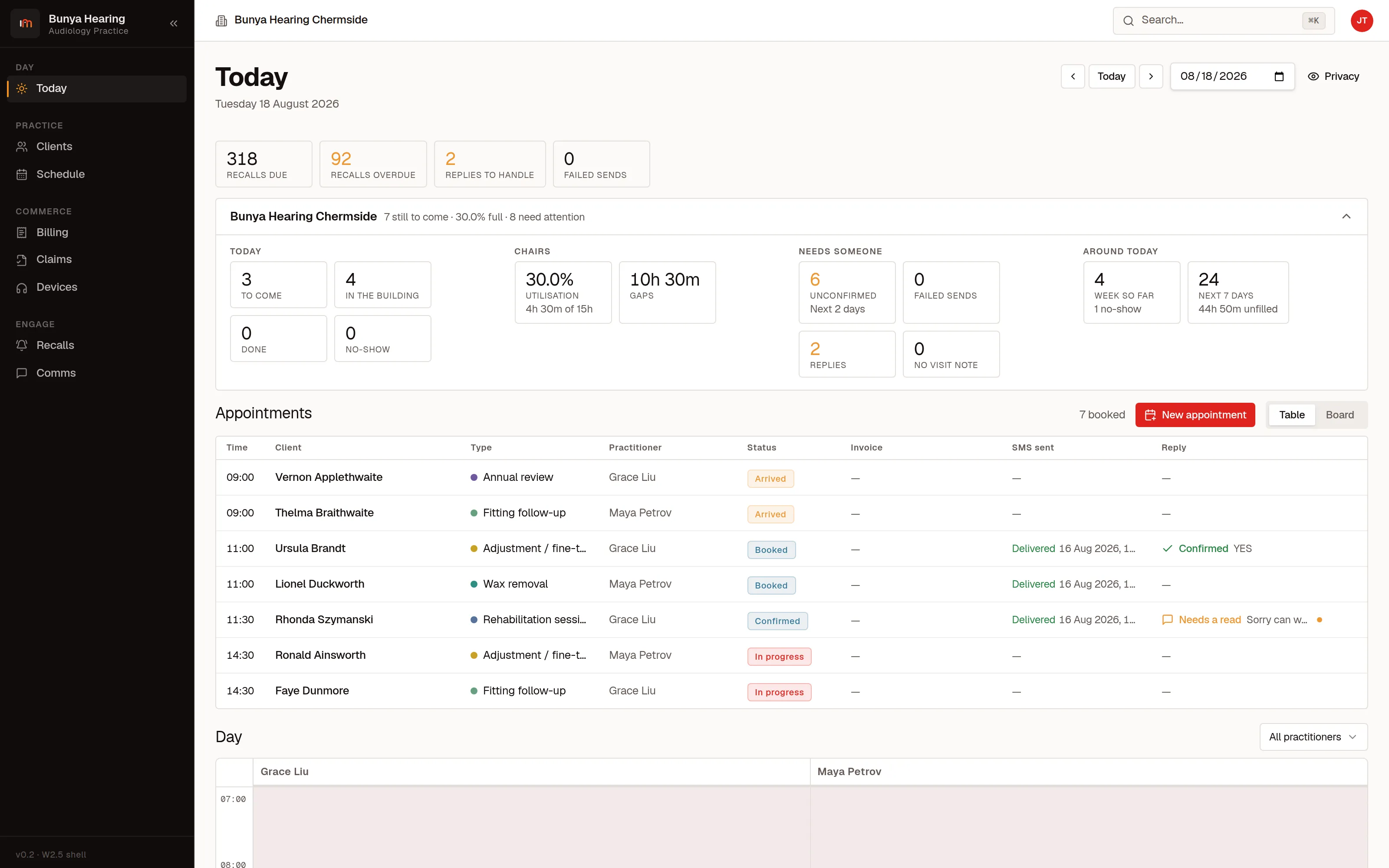
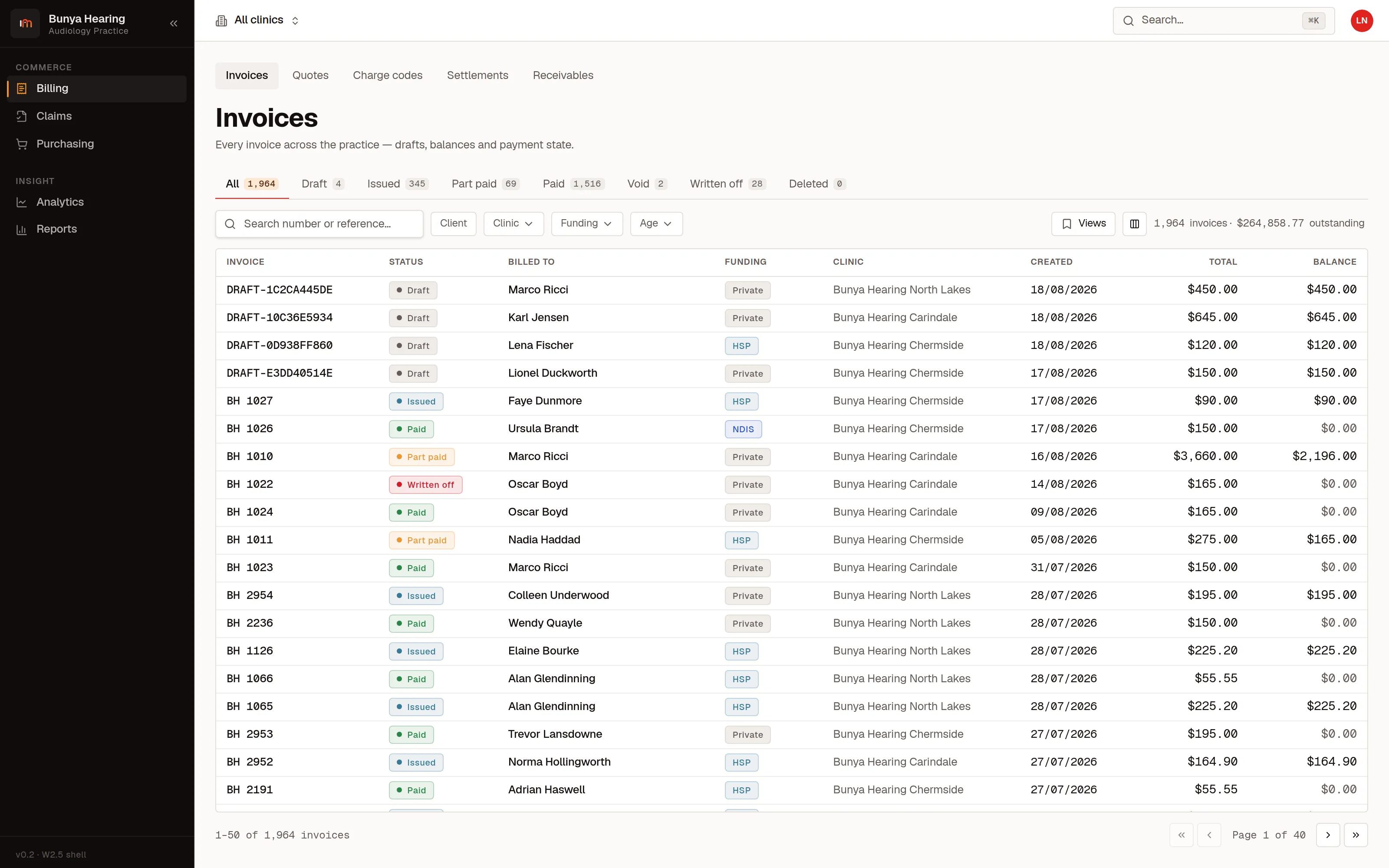
These are real screens from the product, photographed against a demonstration database. The practices, the people, the serial numbers and the claim references are invented, and no patient appears anywhere on this site.
Tell us your shape and we will show you that.
A demo run against your own sites, your funding mix and your audiologists is worth more than a tour of every screen. Say which of the three you are and we will start there.